Monday, July 29, 2019
Saturday, July 27, 2019
Wednesday, July 24, 2019
Tuesday, July 23, 2019
Soulines The Loop Phono Stage
€3090
The Loop phono pre-amplifier is based around pair of NOS ECF80 tubes, employed in the RIAA equalization and MM gain stage, utilizing unique passive RIAA curve equalization, thus providing very neutral sound along with the natural tonal colors of the voices and instruments. The Loop is essentially hand made product, utilizing only components which are carefully selected and matched.
MC step up gain section is done with J-fets in SMD technology, providing a high MC gain suitable for wide range of MC cartridges, along with MC input impedance (MC load) set-up feature for three most common loads, 50ohm, 100ohm and 200ohm, select-able by micro-switches at the back panel of the unit.
NOS ECF80 tubes and all the parts and elements are rigorously hand selected and matched, after extensive measuring and listening tests, in order to provide a great performance. ECF80 tube sets should last for more than 5000 hours, and matched pairs of NOS ECF80 tube sets are available as spare parts.
When designing the all aluminum case-enclosure, we employed our extensive experience from the turntable design and construction, utilizing 10mm thick aluminum panels, strategically damped and solid aluminum cones-feet damped by rubber-cork washers, doing everything in order to provide a stable mechanical base for the electronics and tubes to work.
Along with the standard 230VAC power supply version, 115VAC power supply version is available as well, differing from the standard version only by the different values of mains transformer and fuse used.
Features and characteristics:
Hybrid tube design with ECF80 tubes
MM & MC capability
RIAA accuracy - 0,5dB/20Hz-20kHz
MM gain - 38dB
MC gain - 64dB
Input impedance MM - 47kohm
Input impedance MC - 50,100,200 ohm
Output impedance - 3kohm (load over 20kohm)
Power supply - 230VAC 50-60Hz or 115VAC 50-60Hz
Dimensions WxDxH - 310x280x125mm
Total weight - 6.95kg
Sunday, July 21, 2019
Wednesday, July 17, 2019
Norse Acoustics CL-F1
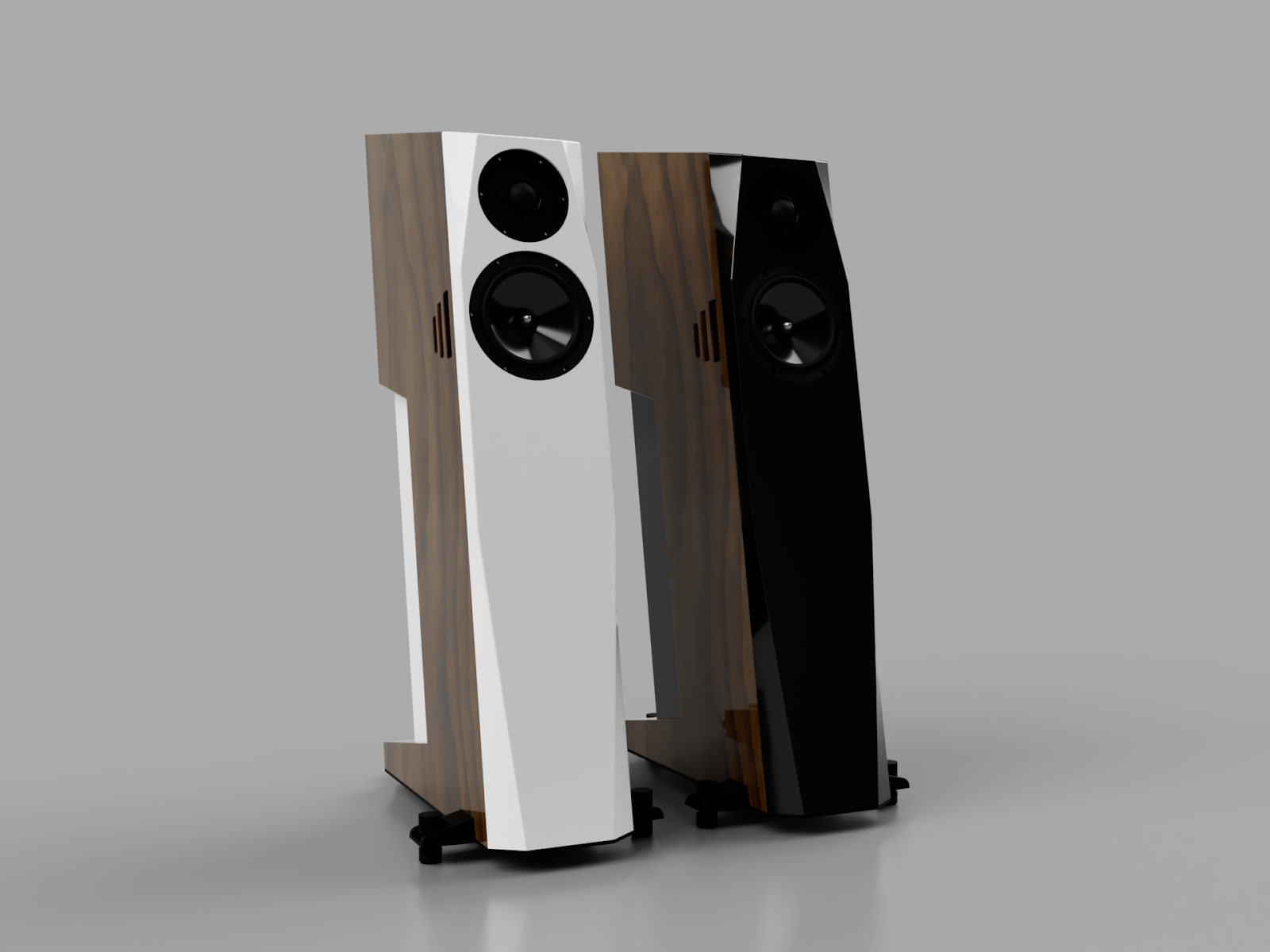
We are very proud to show you the latest concept drawing of the speaker with the internal code CL-F1 (product name not yet decided). This is very close to final product; only minor changes are being evaluated.
This is the passive model, but we are also working on a fully active version to be released later.
The passive version is being designed as a full range speaker for smaller rooms where the two rear woofers are designed to work together with the front wall. This will offer the benefit of more capacity in the bass region as well as reduce the potential for nasty dips due to cancellations caused by reflections.
The midwoofer is in an acoustic resistance enclosure which by controlled leakage cancel out the sound waves traveling backwards towards the front and side walls and reduce the level dramatically. Everything to make the speaker work better in-room.
Monday, July 8, 2019
Audio Consulting Meteor MIPA Amplifier
After many years that we have been selling MIPA amplifiers, the need for a state of the art version of this amplifier has become obvious. Over the last ten years, we also have started developing toroidal versions of our Silver Rock transformers (see Meteor AVC and Meteor MC step up). Using exotic magnetic materials, silver wire and new winding technologies lead us to new levels in transformer performance in audio.
Thermal distortion is a very important factor in audio electronics. It is the major factor that creates the difference between tube electronics and solid state electronics.
Semi conductors do produce thermal distortion whereas tubes do not.There were many research articles published by “Hephaistos” in the magazine “L’Audiophile” between 1977 and 1992 that clearly show that tubes do not exhibit thermal distortion.
We may add that according to our experience, even resistors (among may other evils) do produce thermal distortion as do wires.
In the Meteor Mipa we use new technologies that allow to totally avoid thermal distortion, while at the same time achieve well over 85% efficiency.
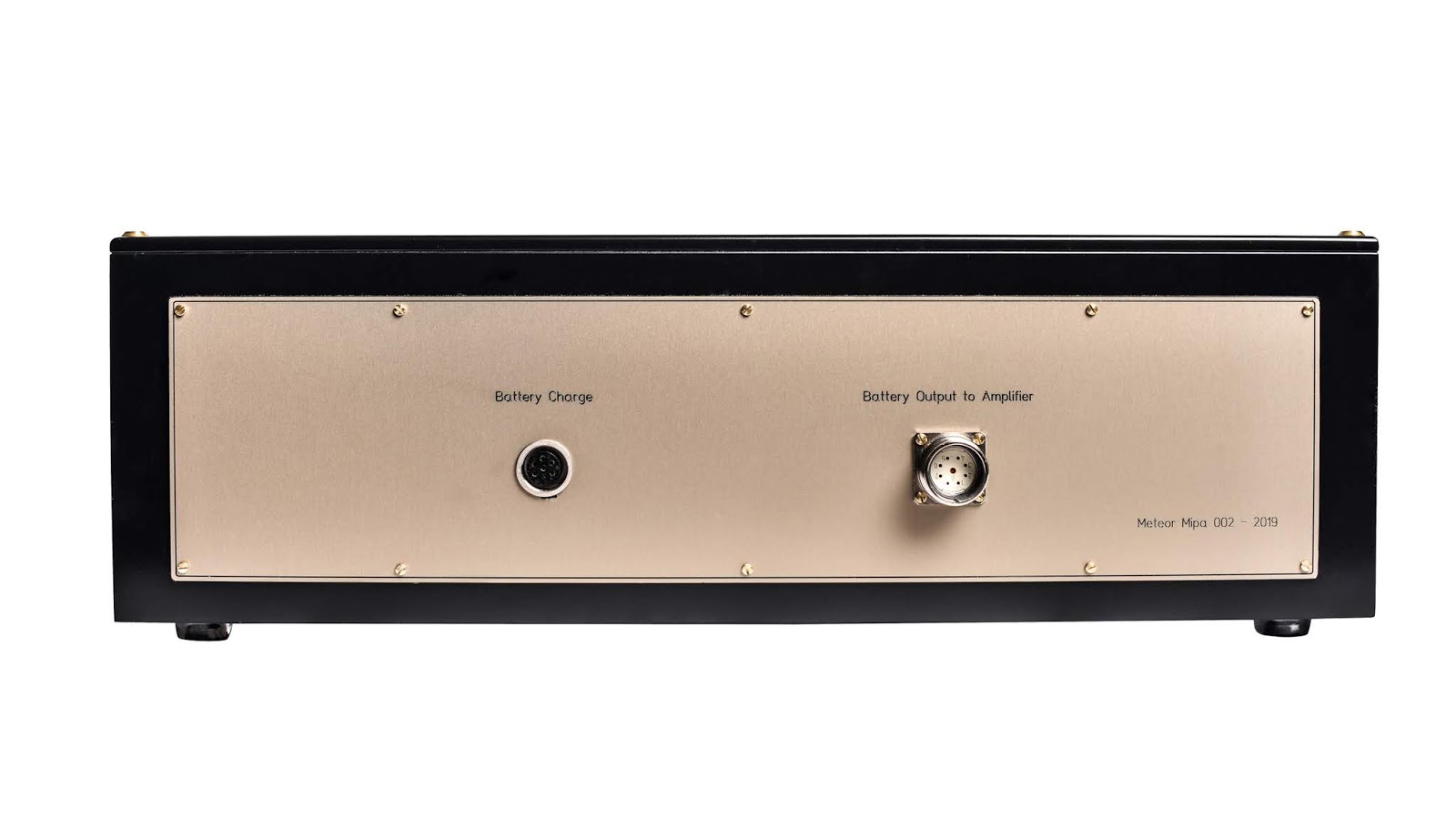
The Meteor Mipa is built using even better power supply capacitors and extremely low tempco and low tolerance resistors. In order to further lower supply impedance, we use external Lithium batteries, which allow for a gain in weight and voltage stability.
The Meteor MIPA comes with one additional cabinets containing the external battery.
The Meteor type of cabinet into which we build the Meteor Mipa is round in all 3 dimensions. This is part of the strategy that avoids standing waves inside and outside the cabinet. This cabinet is CNC milled out of wood and carefully hand finished.
Features:
Toroidal Silver Rock input transformer
Extremely low tempco and low tolerance resistors
Very low distortion power supply decoupling capacitors
Wired using Audio Consulting cotton/cryo silver wire for signal
Wired using very low DCR and very low inductance wire for battery supply and speaker output
Round wooden cabinets for low electromagnetic distortion and low pick up of air born vibrations
Special high frequency shielding
Low impedance Lithium battery power supply
WBT silver Nextgen speaker binding posts
70 w on a 3.5 ohms load
Lacquered black natural wooden chassis 48`500 CHF
Sunday, July 7, 2019
Saturday, June 29, 2019
Wednesday, June 26, 2019
Monday, June 24, 2019
S.A.Lab Samson
We created our amplifying set S.A.Lab from the very ground up. Regarding schematics, technology and incredible sound Samson stands very close to our phenomenal Hercules. New Samson combines powerful and explosive dynamic with quality of sheer musical intellectual. The amplifiers are recognized by audiophiles in the whole world.
It took 1,5 years from us to develop Samson preamplifier and power amplifiers. Samson is push-pull design with Russian 6п36с output tube. There are 6 tubes in ultralinear operating mode in monoblock. Cascode driver scheme is based on Russian 6ж4 (6SA7) as a triode.
Samson’s output transformers are refined those of Hercules and have the same power.
Monoblock’s power supply includes separated transformers for output tubes’ anodes (600 W), tubes heating (400 W) and driver stage (400 W). Power supplying of tubes’ grids and driver stages is regulated.
Samson preamplifier has Russian 6п9 and eight balanced transformer in total: four input and four output transformers. Relay switched ladder volume control is realized on tantalus resistors.
We decorate Samson’s face plates and chassis with luxurious Ferrari paints (many colors for choice).
Technical specifications:
Output power (4 Ohm), W — 250
Signal-to-noise ratio, dB — 100
THD, % — 0,1
Damping factor – 20
Power amplifier dimensions, mm — 770 х 250 х 590
Preamplifier dimensions, mm — 150 х 480 х 450
Power amplifier weight, kg — 65
Preamplifier weight, kg — 20
Thursday, June 20, 2019
Wednesday, June 19, 2019
Channel D Lino C 2.0 Current-Mode MC Phono Preamplifier
Current-Mode Design for automatic gain and cartridge loading
The Lino C 2.0 uses current-mode (transimpedance) circuit technology. A current-mode MC preamplifier amplifies the current rather than the voltage from the cartridge. Consequently, gain and cartridge loading are automatic. This also improves the cartridge's mechanical damping and tracking. With the Lino C's balanced current-mode inputs, ultra-low-noise, hum-free operation is assured.
Mechanical
Beautiful brushed-aluminum chassis. Connectors are the best available, professional quality Neutrik gold contact XLR. Special non-marring isolation feet are directly coupled to the Lino C's rigid and massive internal chassis conferring immunity to external mechanical vibrations.
Rechargeable Battery Power Supply
Rechargeable battery power is a key feature for substantially enhancing the performance of a phono preamplifier. The low-impedance (an effective sink for noise), internally located AGM battery is capable of supplying 50 amperes of current, outperforming all other types of batteries (and supercapacitors) used in audio applications.
Locating the battery inside the preamplifier chassis insures that the battery is in the same electrical environment as the sensitive circuitry, eliminating potential sources of noise pickup. The battery is conditioned and kept float-charged by a proprietary circuit, rather than use an "off the shelf" microprocessor based conditioning and monitoring circuit, which would introduce unwanted noise.
The external charging supply is automatically disconnected when an input signal is detected. Of course, the Lino C may be operated while the battery is charging, or even (if necessary, while waiting for a replacement) with the battery disconnected, by removing an internal fuse. Battery life is 3 to 5 years (or more), and is designed to be easily user-replaceable. We use a readily available type, commonly used for photovoltaic energy storage / alarm systems.
External settings
Gain-structure and mode settings are located on the bottom of the chassis. The set-it-and-forget-it gain-structure setting allows matching the overall output level of the Lino C to your other components. Mode setting allows configuring the balanced outputs for standard phono output or optional "flat" output (gain with no RIAA EQ) allowing optimal use in combination with digital audio and DSP-based RIAA, if desired.
The Lino C's superior technical design features:
Ultra low impedance AGM rechargeable battery used as charge storage reservoir and power supply filter; proprietary, exclusive analog charging and maintenance circuitry specially designed by Channel D and proven, refined and used in our phono stage designs for over 9 years
Balanced* design for lowest noise and improved signal linearity
True single ended outputs obtained by differential summing and balanced signal input for lowest possible noise (high common mode rejection) on single ended connections
Ultra precision (0.1% tolerance) metal film low noise resistors used throughout
German-made ultra-low-dissipation-factor evaporated metal film polypropylene capacitors used in RIAA network, same as in our other phono preamplifiers
Hand selected and matched components insure RIAA accuracy better than +/- 0.1 dB
Info
Thursday, June 13, 2019
Subscribe to:
Posts (Atom)