Saturday, August 10, 2013

Thursday, August 1, 2013

Nagra VI 60th Anniversary Edition


€8000 Ex VAT

Features:
6+2 recording tracks
6 channels (4 Mic + 2 Line) 24 bit, 192 kHz AD / DA
Post-production compatible (BWF/iXML files)
SMPTE / EBU Time Code
Internal 2.5” Hard drive disk and removable Compact Flash
Built-in matrix and two M/S decoders
User programmable Pre-recording buffer
Large colour display
USB 2.0 communication
Lightweight and battery operated
Internal speaker

Product description
The NAGRA VI has been designed as the natural successor to the NAGRA-D / DII multi-track digital recorders. Based on a totally new design concept, the hardware of the NAGRA VI is software dependent and can be adapted simply through software. Available in a choice of three colours ("Slate" grey, "Midnight" blue and "Burgundy" red) allowing owners of two or more recorders easily identify a particular unit. The NAGRA VI is supplied with two plastic "handles" which serve not only to protect the front of the unit from accidental damage, but can also be moved to their lower position and serve to tilt the recorder for a better viewing angle, and easier access to the functions when working on a table-top or sound cart. A carrying case and shoulder strap are also available for over-the-shoulder operation.
The NAGRA VI is delivered with a removable battery box containing a lithium-ion battery pack, a mains power supply and is equipped with a 120GB internal hard disk.

Audio inputs
It offers six independent analogue audio inputs. Inputs 1 - 4 are equipped with traditional NAGRA microphone pre-amplifiers for dynamic and phantom +48V microphones. These pre-amplifiers are a combination of those developed for the NAGRA V and NAGRA-D and are without doubt the best audio inputs NAGRA has ever designed. An audio limiter can be selected for each of these inputs and these can be ganged in pairs if desired. These totally new concept input circuits offer the best specifications ever produced by any NAGRA in terms of pure audio quality. The four "In-house" transformers offer fully floating inputs for the dynamic microphones, giving a greatly improved signal-to-noise ratio. The remaining two analogue inputs are LINE level inputs for connection to other equipment supplying a line level signal, such as radio receivers. When set to the LINE position all 6 analogue inputs will accept up to +24dB. The two input connections (channels 5 + 6) double up as 2 AES inputs (A and B) when selected to digital input mode.

Zipper noise suppression
The NAGRA VI does not use traditional logarithmic potentiometers for the audio levels as were traditionally used on previous Nagra models. Today digital “encoders” are preferable because they do not suffer from “crackling” noise problems, and can be programmed to fulfill a multitude of different operations depending on the software program controlling them. Equally, even the graduation of the sweep is software calculated and can be altered relatively easily, rather than being created by the precision winding of the internal coils during manufacturing.
However, such encoders normally suffer from a phenomena known as the “Zipper” noise. The NAGRA VI benefits from a complex development in a suppression system used on every level control of the recorder. The end-result is that the potentiometers can be moved instantaneously and no digital zipper effect can be heard.
The potentiometers on the Nagra VI behave in exactly the same manner as the traditional logarithmic potentiometers used in Nagra analogue recorders but with the advantage of the precision offered by digitally controlled encoder devices, and hence an increase the perfection of all recordings.


The left side panel clearly shows not only the analogue and digital audio input connections, but also the external 4 pole XLR DC input socket, allowing the NAGRA VI to be externally powered from an external DC power source such as a car battery. The 5-pin LEMO SMPTE/EBU time code In/Out can also be seen as well as the two HIROSE connectors used for powering external accessories such as radio receivers. These two connectors can supply up to 1 A at 12V.


The right side of the recorder is where the removable compact flash card is located. A LED next to the slot indicates when the card is accessed. The stereo analogue outputs, and the main AES out as well as the second headphone connector can be clearly seen. Additional AES outputs are located on the 15 pin Extension connector. The Start / Stop terminal is a fader start (contact closure) command as found on other NAGRA recorders. Two USB (host / device) connectors are also located on the right side next to the card slot.

Recording medium and format
The NAGRA VI records to a 120GB internal 2.5" hard disk. An extractable compact Flash card is used to record a copy of the audio tracks depending on the users track selections. The NAGRA VI allows approximately 20 minutes of 6 track 48 kHz 24-bit recording per GB of available disk / card space. The compact flash card section is equipped with a "Hot-Swap" possibility meaning that the CF card can be removed and replaced while the NAGRA-VI is powered up, without causing any damage to the card or the recorder. The NAGRA VI records using Broadcast Wave File (BWF) format and is iXML compatible for the metadata making the files compatible with all modern post-production equipment.

The NAGRA VI is equipped with a sunlight-readable 3.5" colour TFT display with a resolution of 320 x 200 pixels. This specially designed high luminosity display is used to visually indicate not only the status of the NAGRA VI but also the bargraph modulometers, take number, time code and the current operating modes of the machine. When in the menu mode, the audio levels can be monitored using the LEDs on the front panel.

File back-up
The NAGRA VI is equipped with two USB 2.0 ports. One is designed to connect the NAGRA VI to a computer for file transfer. The second is a "host" connection and although currently unused, it is planned to be used for connection of an external device such as a keyboard.

Time code
The internal time code system and all the internal digital electronics of the NAGRA VI are clocked by a crystal which is a "Stratum III" TCXO which has been artificially aged in an oven to maintain stability. This crystal gives a guaranteed overall stability better than ±4.6ppm over a period of 15 years throughout a temperature range from -20°C to +70°C. The drift due to temperature changes is less than 0.28ppm. This is the most accurate crystal ever used in an NAGRA recorder. The NAGRA VI will handle all the standard SMPTE / EBU frame rates as well as the 23.976fps rate for the HD format. All the frame rates can be pulled "up/down" for the NTSC markets.

Technical Specifications

Recording
Data storage medium 120 GB Internal hard disk
Removable media Compact Flash type I / II (Hot Swappable)
Disk format FAT 16 / 32
Recording Method Linear digital PCM
File type 16 / 24 bit Broadcast Wave File BWF (WAV) with iXML, AES 31 compatible
A/D & D/A conversion 24 Bit Sigma Delta
Tracks 6 individual
Sampling Rate 44.1, 48 kHz, 88.2, 96, 176.4 and 192 kHz (with 0.1% pull up/down)
Recording capacity 20 mins of 6 track 24 bit 48 kHz per GB of disk / memory
Mono / polyphonic Selectable
Pre-recording buffer Up to 10 seconds @ 48 kHz 24 bit on 6 tracks.
Display 3.5 inch colour LCD TFT
Level meters On colour display AND by LED for microphone inputs

Inputs
Digital inputs 2 x XLR AES-3 shared with analogue inputs 5+6
Analogue inputs 4 x symmetrical XLR Microphone (Dynamic, +48V Phantom) / line

Microphone input sensitivity 2.8 and 10 mV/Pa selectable
Limiters Selectable on microphone inputs, individual or in pairs. Active at -7.6dBFS, max +40dB for -2 dBFS
Line input sensitivity Adjustable from -6 dBm up to +24 dBm for 0 dBFS recording
THD at 1 kHz 0,1% mic, 0,01% line
Frequency response Mic, 10Hz - 48 kHz ± 0.5 dB, Line ±0.2 dB (measured on AES out)
Input noise with condenser mic 0.88 µV (-119 dBm)
Input noise with dynamic mic 4 dB (measured ASA "A" loaded 200Ω
Signal-to-noise ratio >114 dB
Input level adjustment range 50 dB Mic and from -6 to +24 dB Line
Input filters LFA (with vortex filtering)
Slate microphone Electret behind the front panel
 
Outputs
Analogue line output 2 x XLR 4.4V max (+15 dBm)
Digital output XLR AES-3 (24 bit or 16 bit dithered)
Headphones 2 x Stereo 6.3mm (¼”) Jack 50 Ω
Internal speaker 1W
 
Other
USB Host USB 2.0 connector type "A"
USB Device USB 2.0 connector type "B"
Time code IN/OUT 5 pin LEMO (SMPTE / EBU)
M/S Decoder Switchable
Monday, July 8, 2013

3 Million Hits


This blog is still very popular, thank you all visitors.

Wednesday, May 29, 2013

Chasing The Dragon - Audiophile CD


Reviewer and recording engineer Mike Valentine has just completed a 2 year journey, recording acoustical instruments all over the world. He has used 50 year old valve microphones in a Decca Tree Array on some of the tracks and employed  a state of the art high resolution digital recorder.

The tracks were all mixed on a 25 year old Neve desk in an effort to produce an analogue sound and mastered in London using cutting edge technology. A 16 page booklet has been produced so that you may see how each recording was made.

At last year's UK National Audio Show reviewer Jason Kennedy voted "Chasing the Dragon" as the best sound of the show.

Link

Wednesday, March 20, 2013

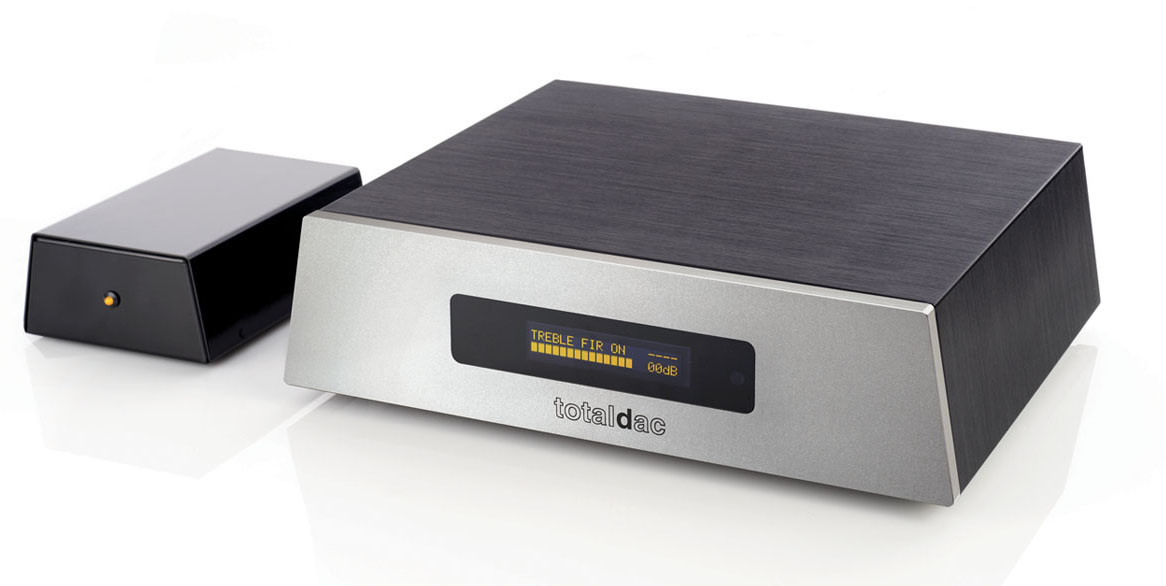
Totaldac D1-server


€5000

A music server will be available. The D1-server is integrated in a D1-digital reclocker which guaranties a low jitter and low noise with digital preamplifier functionalities such as several auxilary digital inputs, all de-jittered by the internal reclocker.

The D1-server should be in demo at 2013 Munich High End show.

Thursday, March 14, 2013

Thrax Maximinus Dac


€24000

Universal DSP controlled discrete resistor ladder 32bit/384kHz audio dac without output buffer or filter at the dac output providing the cleanest possible output signal.

We also use separate power supplies for (not separate regulators but physically separate transformers and all) the Converters, Clock, DSP and Control logic all with floating ground planes and our unique constant current regulator technology.

Wednesday, March 13, 2013

LongDog Audio VDti DAC


£3000

It accepts DSD over the USB input.

LongDog Audio

Monday, March 11, 2013

Totaldac D1-tube DAC


Totaldac's discrete Vishay metal-foil R2R platform expands with the model D-1 [€6.960] which adds one ECC82/12AU7 per channel for 600-ohm output impedance and 1.2Vrms output on both RCA and XLR.

The 24/192 async XMOS USB transceiver is compatible with JPlay's 24-bit 'extreme hibernate' mode. A digital volume is included and the power supply is external.

Friday, March 8, 2013

Audiobyte Unimorph Dac


€3000

D/A Converter with quad-multibit PCM 1704 R2R converters and asynchronous FIFO technology.


Audiobyte

Tuesday, March 5, 2013

Saturday, February 16, 2013

Audio Research VSi 75 integrated amplifier


$8000

Specifications
Power Output: 75 watts per channel continuous from 20Hz to 20kHz. 1 kHz total harmonic distortion typically 1.5% at 75 watts, .05% at 1 watt.
Approximate actual power available at “clipping” 80 watts (1kHz). (Note that actual power output is dependent upon both line voltage and “condition” i.e.: if power line has high distortion, maximum power will be affected adversely, although from a listening standpoint this is not very critical.)
Power Bandwidth: (-3dB points) 12Hz to 70kHz.
Frequency Response: (-3dB points at 1 watt) 1.0Hz to 70 kHz.
Input Sensitivity: 0.55V RMS Single-ended for rated output. (32.5dB gain into 8 ohms.)
Input Impedance: 52.5K ohms Single-ended.
Inputs (5): 1, 2, 3, 4, 5 (Single Ended RCA connectors).
Maximum Input: 10V RMS (any input).
Output Polarity: Non-Inverting (any input).
Push Buttons: Volume up, Volume down (103 steps), Power, Input, Mute, Bias. All functions on IR remote control.
Output Taps: 8 ohms, 4 ohms.
Output Regulation: Approximately 2dB 8 ohm load to open circuit (Damping factor approximately 4).
Overall Negative Feedback: 4dB.
Slew Rate: 10 volts/microsecond.
Rise Time: 4 microseconds.
Hum & Noise: Less than 1.0 mV RMS -88dB below rated output (IHF weighted, Vol down).
Power Supplies: Electronically regulated Low and High voltage supplies for input stages. Automatic 40 sec. warm-up/brown- out mute.
Power Supply Energy Storage: Approximately 350 joules.
Power Requirements: 100-125VAC 60Hz (200-250VAC 50Hz) 400 watts at rated output, 600 watts maximum, 210 watts at
“idle’: 1.0 watt power off.
Tubes Required: 2-Matched pair KT120-Power Output; 2 -6H30 driver.
Dimensions: Width 14.5” (36.8 cm) Height 9.25” (23.5 cm)
Depth 16.25” (41.3 cm) Rear connectors extend .88” beyond chassis.
Weight: 36.4 lbs. (16.5 kg) Net; 49.3 lbs. (22.4 kg) Shipping.

Friday, February 15, 2013

Bibacord Cable


From Sweden.

Prices in SEK

Interconnect
2x1m - 20,000
2x2m - 30,000

Speaker
2x1m - 25,000
2x2m - 39,000
2x2,5m - 45,000

Friday, February 8, 2013

Totaldac D1-digital reclocker


€3950

The D1-digital is a new concept of reclocker. It aims at improving the sound of a digital system.
It is connected between a drive (CD player, computer with USB, music server) and any 24bit DAC.

The D1-dual uses the same technologies as the D1-dual DAC but the analog outputs have been replaced by digital outputs.
So it has multiple digital inputs, an 69bit volume control which can be used or not and even more interesting a FIFO memory and an internal clock which attenuates the jitter of any digital source.

So the D1-digital reclocker is compatible with all available drives and all available DACs.
It can be also used as a USB to AES-EBU or spdif converter with high sound quality.
Even associated with the D1-dual it can de-jitter any digital source to get an unexpected better sound when the source is a computer, a music server or a CD drive.

-192KHz asynchronous Xmos USB, optical, RCA and AES-EBU digital inputs, selectable from a remote control.
-44.1KHz, 48KHz, 88.2KHz, 96KHz, 176.4KHz and 192KHz, 16 to 24 bit formats supported on all inputs except 96KHz max for optical input.
-USB input compatible with Jplay in 24 bit "extreme hibernate" mode.
-AES-EBU and spdif (RCA or BNC) digital outputs.
-69bit digital volume control, adjusted by a remote control and an OLED display. The remote control receiver can be disable by a switch to dedicate the remote control to the D1-dual when the D1-digital stettings are finished and saved.
-phase polarity selected by remote control.
-display switch off by remote control or automatic.
-all unused inputs are completely disconnected (including the ground) to keep the optimum noise floor even when several sources are connected.
-external power supply to minimize the noise.
-aluminium and PMMA enclosure.
-power consumption 18W.
-DAC dimensions: height 110mm, width 360mm, depth 290mm.
-power supply dimensions: height 65mm, width 122mm, depth 180mm.

Available options:

-silver massive aluminium front panel and silver lid.
-Adjustable 12dB/oct high pass filter for D1-dual, to attenuate sub bass to solve a room acoustics problem or to protect the loudspeakers or to remove sub bass when listening with a headphone or to remove the recording offset or to preserve neighbours or children at night.
-115V power option.
-BNC coaxial digital input and output instead of RCA.
-D2-digital, 69 bit 2 way active crossover including the main volume control and also for the relative level between bass and treble. The crossover slope can be 6dB/oct, 12dB/oct or 18dB/oct. All parameters, crossover frequency, filter slope, relative volume, main volume, relative digital delay... can be controlled from the remote while listening to music.

Thursday, February 7, 2013

Sunday, February 3, 2013

FM Acoustics 268+1811


Both units is FS at a dealer in China.
Both are brand new and can only be bought together as a set.
No discount so total price is $280,000.

Not every day this set is FS as there is 6 months waiting time.


A 115 pair on top of 1811.

T+A PA 3000 HV Integrated Amplifier


€9900

Power output in 8/4 ohm - 300/ 500 watt.
12 10,000uF capacitors.

In mid-2013 T+A will release the preamplifier P 3000 HV, and the 500 watt stereo or 1000 watt mono poweramplifier A 3000 HV.


Info

Monday, January 21, 2013

Nagra LB sound recorder


£2600

Great for making a digital recording of LP's. Up to 24/192k can be recorded.
Just connect it directly to the phono stage.

Manual

Sunday, January 20, 2013

Music Culture Technologies Mc 1010 Music Server


$5000

Based on the excellent Vortexbox Engine, MC's new server will feature up to 32-bit/384kHz PCM and DSD DoP v1 playback.

This unit will be compatible with a wide variety of bit and sampling rates, file types and has an output via the SOtM USB card, S/PDIF. An optional internal DAC board is also available.

The 2TB of internal storage may be controlled via free iOS / Android app.

Thursday, January 17, 2013

Struss R550 Integrated Amplifier


€35000

The Struss R550 is a new generation amplifier, offering an extremely dynamic and detailed sound, while still natural and without the distortions associated with transistor devices. The chief constructor's dream was to obtain the "live music" effect at home. The dream came true after years of work on the Struss R550 the effect of live music with the particular associated system has been reached. Many owners of the Struss R550 amplifier confirm the above opinion. Also Russell Kauffman (Morel Europe) gave the R550 very good feedback, stating that today it is the best and the most powerful amplifier in the world (dual mono). The opinion was formed after many hours of testing of the R550 width the best Morel speakers "Fat Lady".

The Struss R550 amplifier does not possess its own features. Instead, it reinforces exactly what it is given and gives out everything that the speakers can cope with. The technical solutions used are owned by the company and are registered with the numerous patents. The amplified channel constitutes a fully balanced system supplied with two electrolytic compensators with a total capacity of 176 000 uF and two toroidal transformers with a capacity of 2.0 kW (2.8 kW peak), each magnetically and electrostatically shielded. It is the tradition of this company not no include any bipolar transistor in the entire amplified system.

The surreal design is not a matter of chance. The beauty of its compact design is combined with the graphics of one of the most successful post-war Polish artists, the author of many prominent surrealistic works of the contemporary art.

The launch of the new R550 Struss amplifier by the Struss Amplifiers Company proves that the most powerful amplifier in the world (2 monoblocks) can be designed and produced in Poland.

Technical parameters:

Power RMS/Music: 2 x 550 W/8 Ω, 2 x 1000 W/4 Ω (DIN 45500)
Minimum load: 0,5 Ω (momentary)
Distortions THD: 0,05 % with a power of 1 W, 0,025 % of the power of 500 W - load 8 Ω
Frequency Response: 2,5 Hz - 300 kHz +/- 0,05 dB/ 1 W/ 8 Ω
S/N ratio: 145 dB (IHF - A)
Dynamic Range: 140 dB
Inputs: 4 x Universal - RCA, XLR (balanced), separated CD - RCA voltage output for external devices
Security system: advanced against short-circuiting of the speakers and the appearance of the output voltage
Indication of "peak": approaching the maximum output
Transformers: 2 x toroidal, magnetically and electrostatically isolated, power 2000 VA each
Remote control: RC5 code (volume)
Power consumption: 200 VA - 4 500 VA (peak)
Work in Class A: 2 x 55 W
Net weight: 54,5 kg
Dimensions: 530,3 x 155 x 430 mm
The amplifier meets all the requirements and standards applicable in the EU
Manufacturer Warranty: 36 months

Wednesday, January 16, 2013

Dalby Ultimate Ground Wire U-1000


DAD is proud to announce the exclusive D7-1000UE Earth cable. Handmade using mineral loaded pure silver and mono crystal litz copper conductors. Clothed in 9ct gold over brass housings with solid silver spade terminations. Rated conservatively at 70A.

Available in 1.8m and 2.5m lengths. TSP. £5,995.00 GBP (1.8m)

Tuesday, January 8, 2013

Burmester 101 Integrated Amplifier


The 101 Integrated Amplifier is the latest integrated amplifier in the Burmester product range and a supreme example for the perfect combination of efficient class D power sections and an analogue power supply. With its power reserves thus made available the 101 easily achieves in a compact design the warm and well-balanced sound which is known to be a trademark of the Burmester tone. The switchable "Smooth“ function produces a rounded and detailed sound image even with low volume levels.

Within the Burmester sound world the 101 integrated amplifier commends itself as a perfect game partner for the 102 CD player, notably when combined with the loudspeakers from the Burmester portfolio. The additional balanced outputs also allow to use it as a dedicated preamp or upgrade it with external power amps at a later time.

As you would expect it from Burmester, the 101 also features a balanced circuit layout and is DC-coupled, meaning it dispenses entirely with distorting coupling capacitors in the signal path.

Power output  120 watt

Thursday, January 3, 2013

CH Precision Ethernet audio streaming board


Ethernet audio streaming board (renderer) for the C1 Digital to Analog Controller. Enables bit-exact, low-jitter play-back of high resolution audio files over an Ethernet network. Tablet based control application.

Supported formats: FLAC, WAV, AIFF, Apple Lossless (ALAC), MP3 and AAC audio formats with up to 24bit/192kHz native sample rate.

High Fidelity Cables CT-1 speaker cables


.

Lumin Audiophile Server


Intro price $4000

Info

Wednesday, January 2, 2013